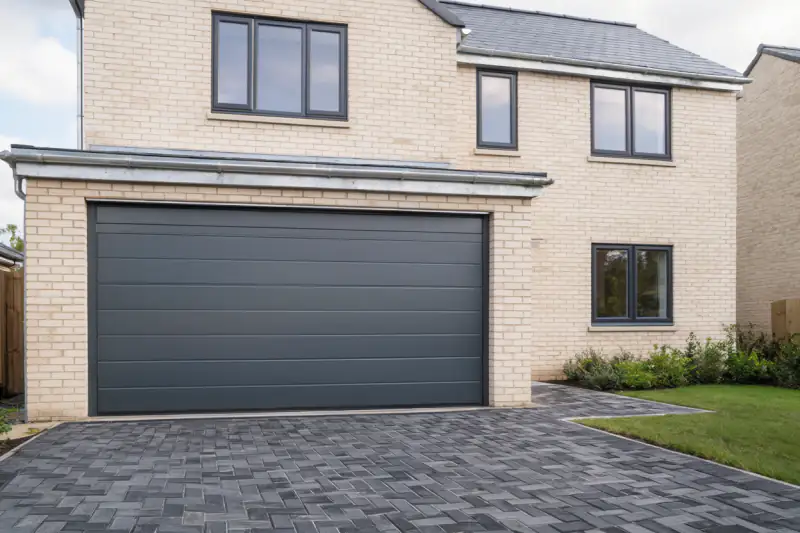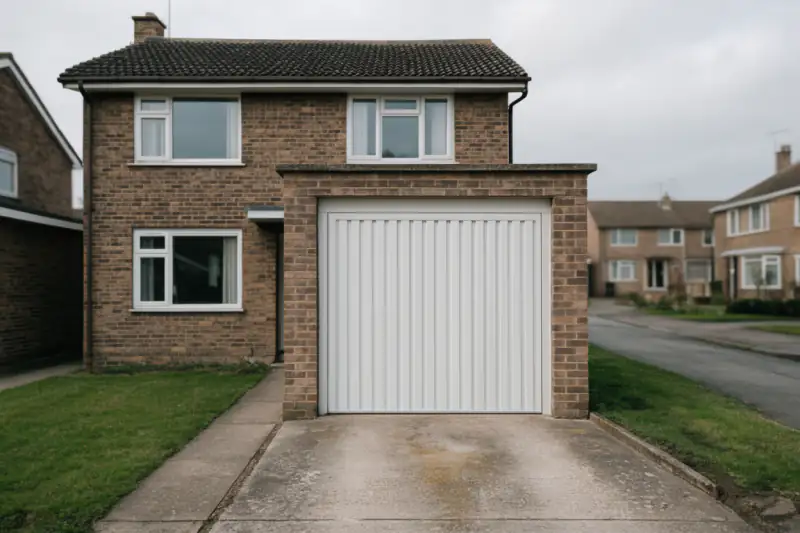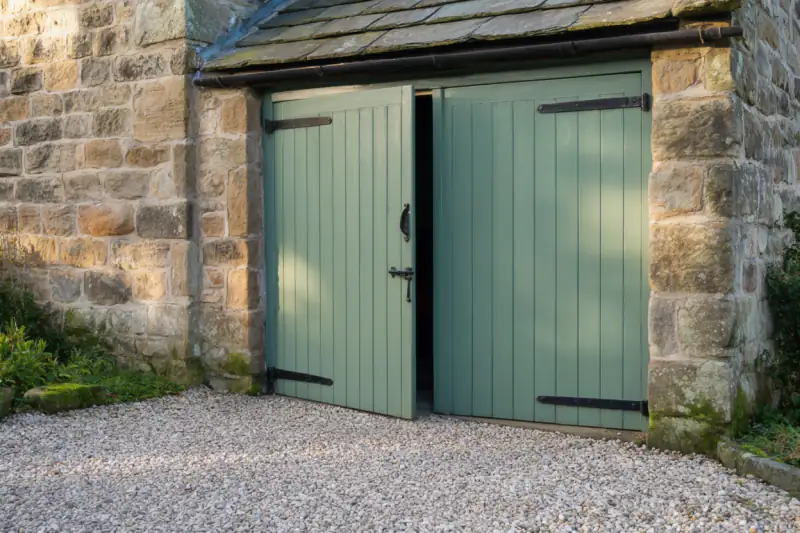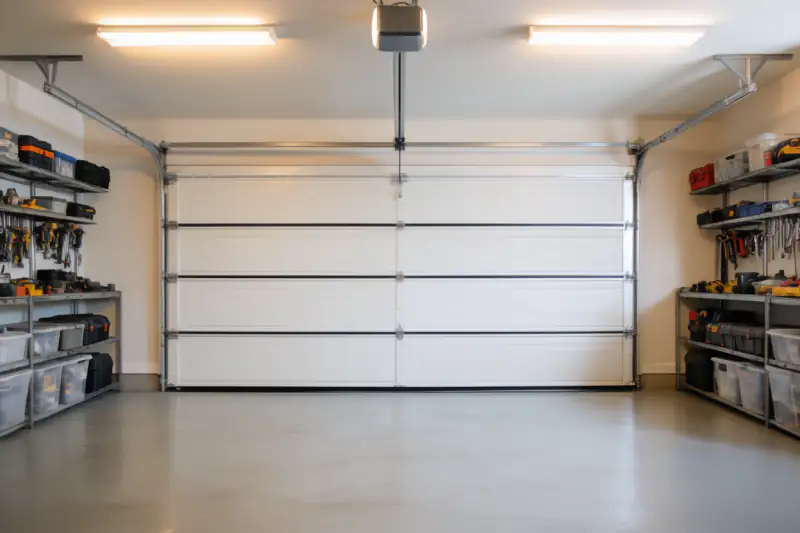
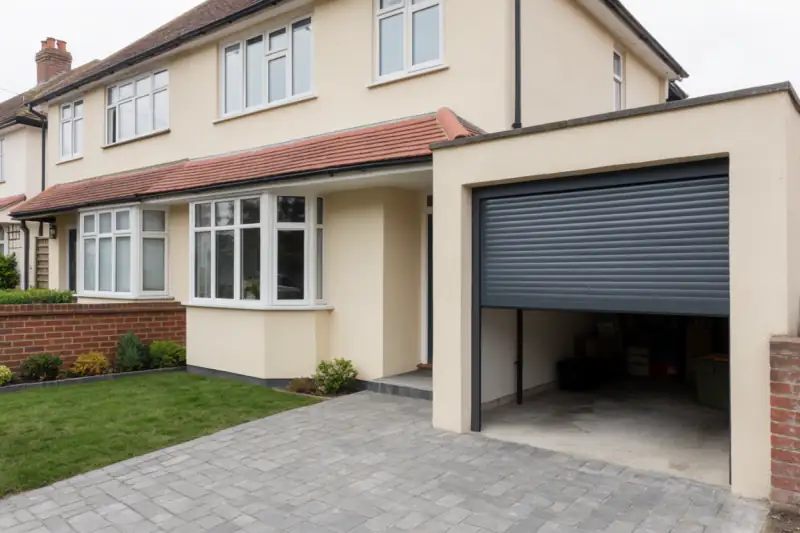
An electric roller garage door is a curtain of slim slats that winds around a barrel in a box above the opening. Nothing swings out and nothing runs along the ceiling, which is why it suits short drives and garages used for storage. Typical 2026 UK guides put one at £900 to £2,000 fitted for a single garage. Before you order one, you need to know how it works, where it falls short and how much room the box takes.
How a roller door opens and closes
The curtain is made of linked slats, usually aluminium and often filled with foam. Its edges sit in guide rails on either side of the opening. When you press the remote, a motor turns the barrel. The curtain then winds up on itself, one slat at a time, until it is all inside the box.
Because the curtain travels in a straight line, it never comes towards you, so you can pull up close before it opens. Nothing reaches back into the garage either.
What stops it closing on something
A domestic powered door falls under BS EN 13241, which covers force limits and obstacle detection. In practice, the door should stop or reverse when it meets resistance. Photocells across the opening add a second layer by spotting a person or a bike before the curtain touches it. We test these before handing the door over, and we show you how the manual release works on your model.
Who a roller door suits, and who should think again
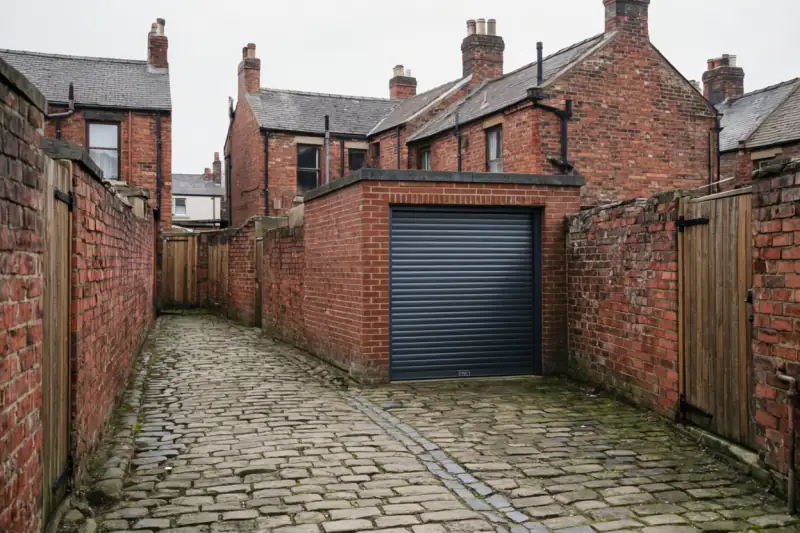
A roller door earns its place where space is tight. Terraces in Newcastle, such as those in Heaton and Sandyford, often have garages on narrow back lanes. A door that swung out would block the lane, whereas a roller stays inside its own line. Short drives have the same problem on a smaller scale, because a car parked close to the door can stay where it is.
It also works well in openings that are awkward for tracks, including curved ones. If you want shelves, bikes or a kayak hung overhead, the free ceiling is a real gain.
There are good reasons to look elsewhere, though. A garage that sits under a bedroom or shares a warm wall with the house is usually better served by a sectional door, which seals and insulates more closely. Slats will never give you the look of raised panels. Where the lintel has very little space behind it, the box may not fit at all. And when your existing door is still sound, adding a motor to it costs far less than replacing it.
How much room does the box need?
Headroom decides most roller door jobs. The curtain has to wind up into the box, so a taller door makes a fatter roll and needs a bigger box. There is no single figure that fits every garage, which is why we confirm it when we check the opening.
These are the measurements that help us most:
- The width of the opening, taken at the top, middle and bottom.
- The height of the opening, taken at both sides.
- The depth from the top of the opening up to the ceiling or roof timbers.
- The space beside the opening on each side, inside the garage.
Behind the opening or within it?
Roller doors are made to measure and can usually be fitted behind the opening or within it. Fitting within the opening hides less of the brickwork, but the guide rails take a little off your width. Fitting behind can keep the full brick-to-brick width, which matters in older garages built when cars were narrower. It is often the better option for a tight fit, provided the wall behind gives the rails something solid to fix to. Getting that choice right is a big part of a good roller door installation.
Which motor does a roller door use?
Most roller doors do not use the chain, belt or direct drive openers you see on other doors. Those run along a rail under the ceiling, which would defeat the point. A roller door normally has a tubular motor inside the barrel, so it is hidden in the box and comes as part of the door. You rarely have a separate motor to choose, and the fitted guide price already includes it.
The choices that are left concern power and control. The motor needs a supply near the box, which is high on the wall in most garages. If there is nothing within reach, a qualified electrician should add it first, and a new socket typically costs £80 to £150.
For control, look for a rolling-code remote, because the code changes on every press and is much harder to copy than an older fixed code. A smart module can add phone control, and a battery backup keeps the door running in a power cut. It is especially useful if the garage is your only way in.
What a roller door typically costs
These are typical 2026 UK guide figures for a single garage, and they are not our price list. Your own quote will depend on the size, the finish and how the door is fitted.
| Item | Typical guide figure |
|---|---|
| New electric roller door, fitted | £900 to £2,000 |
| Roller door, supply only | £700 to £1,400 |
| Wi-Fi module | £30 to £60 |
| Battery backup | £50 to £120 |
Some guides quote up to about £3,200 for a roller door, so a large or highly specified door can go past the usual range. The gap between fitted and supply-only prices may look small, but fitting one means fixing the box and rails true, connecting power and setting the safety systems. Running costs are low, at under £25 a year for most households. Our price guide sets these figures against the other door types.
Looking after a roller door
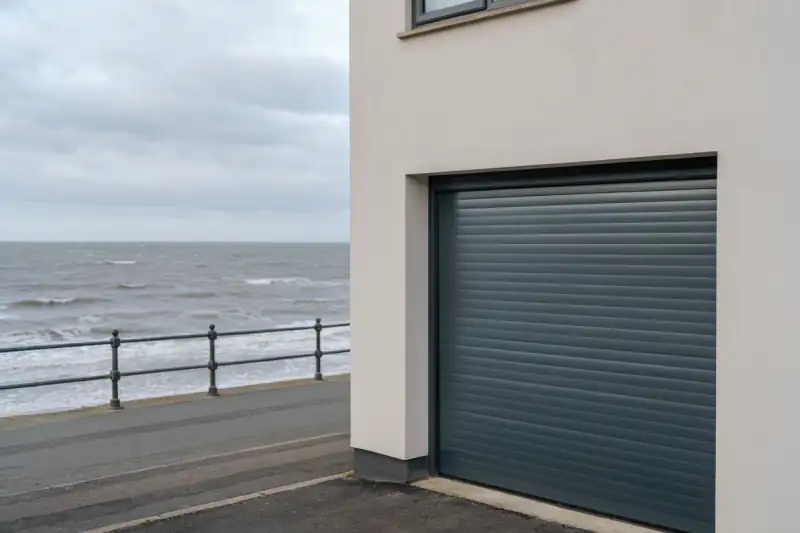
Most of the care is about keeping the guide rails clear. Grit, leaves and cobwebs collect at the bottom of the rails, and that is where a curtain starts to catch. Brush them out now and then, and wipe the slats with mild soapy water. Homes near the coast should rinse the door more often, because salt air is hard on fixings even when the slats are aluminium.
Once a month, check that the door stops for an obstruction and for a broken photocell beam, following your manual. Keep the photocell lenses clean as well, since a dirty lens is a common reason for a door refusing to close.
A curtain that leaves its rails, or a slat that gets dented by a bumper, needs proper attention. Stop using the door, leave the box closed and send us the details so we can look at a repair, because the parts inside the box are under tension and are not safe to handle yourself.
If a roller door sounds right for your garage, the next step is easy. Fill in the quote form at the top of this page with the width, the height, the depth above the opening and a photo if you have one. We will tell you whether the box fits and which options make sense for your home.