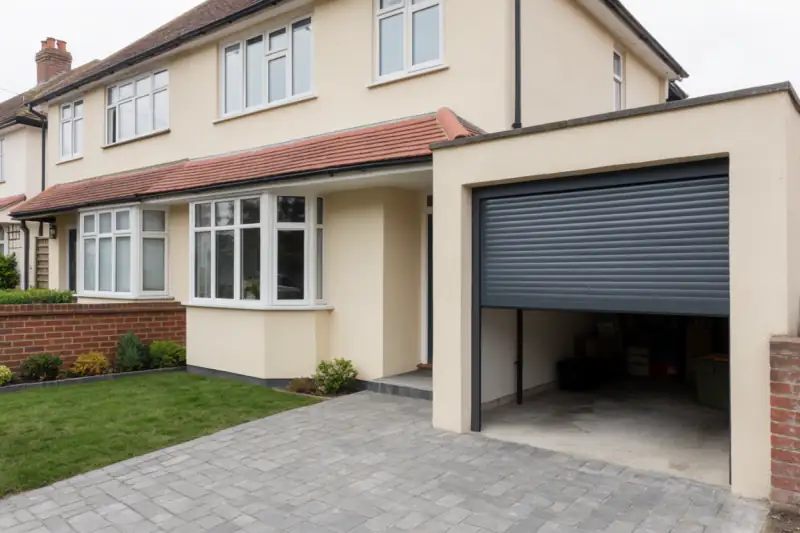
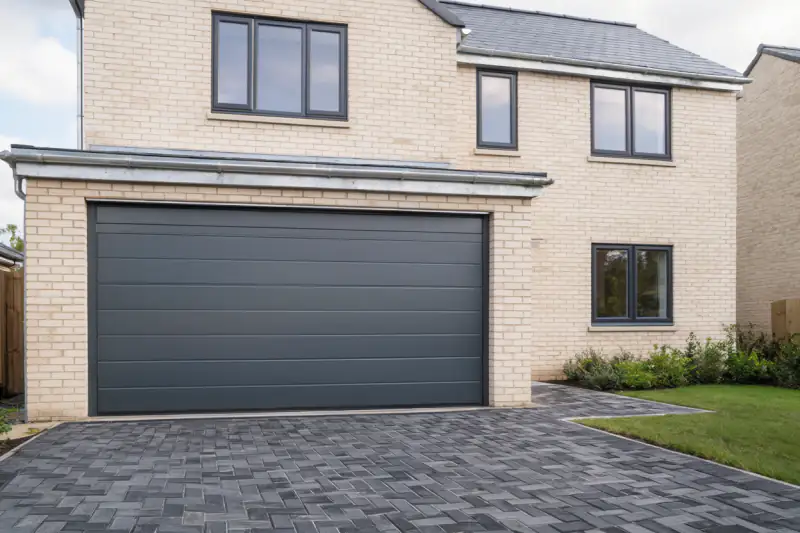
A sectional garage door is a set of horizontal panels, hinged together, that run up on side tracks and park flat under the ceiling. It is the strongest all-round choice for an attached garage or a wide double opening, because it seals well and asks for no room on the drive. The trade-off is the ceiling, which the door takes over when open. Typical 2026 UK guides show £1,200 to £3,000 fitted for a single door.
What happens when a sectional door opens
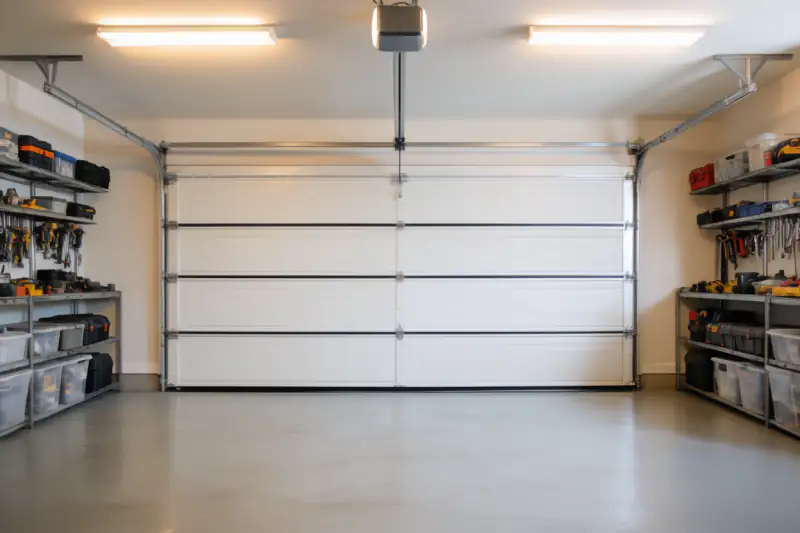
Rollers on the edge of each panel sit in a track on either side of the opening. As the door lifts, the panels travel straight up, then bend around the curve at the top one hinge at a time. They finish lying level, just below the ceiling.
Springs and cables carry most of the weight, so the motor only has to guide a door that is already balanced. This also explains why a broken spring is serious. That stored tension can do real harm if it is released suddenly, so springs and cables must be left to someone who does this work.
Why the panels seal so well
The panels are usually double-skinned with insulation inside, and rubber seals sit at each joint. When the door closes, those joints press together and the bottom seal meets the floor. A one-piece door has to do all that sealing around its outer edge, so a sectional door has a clear advantage against draughts and wind-driven rain.
Is a sectional door right for your garage?
It usually is if the garage is attached to the house, because a cold, draughty garage beside a living room affects the room as well. The same goes for double garages. Larger homes around Ponteland and Darras Hall often have openings on this scale, where a single wide door is easier to drive through than two narrow ones.
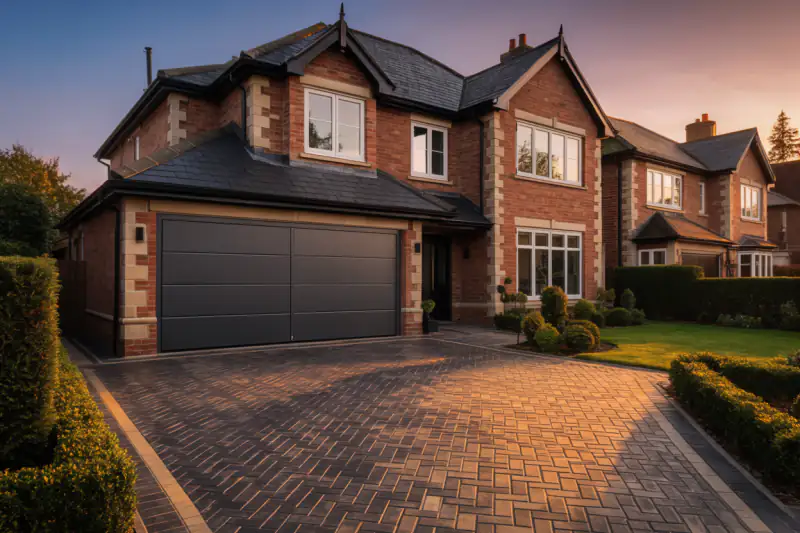
Looks are another reason people choose one. There is a wide range of panel styles, colours and finishes, so the door can match your windows and front door. On a house where the garage takes up a large part of the front, that makes a visible difference.
It is the wrong choice in a few situations. If the ceiling holds your storage, a loft hatch or a low beam, the tracks and parked door will get in the way. In that case, a roller door leaves that space free. If your budget is tight and your present door works, adding an opener to it will cost far less. Our roller and sectional comparison goes through the choice in more detail.
Space inside the garage matters more than space outside
Standing on your drive, a sectional door seems to need no room at all, but the real measuring happens inside. The tracks need headroom above the opening so they can curve, and a strip of wall on each side for the vertical runs. Behind that, the door and tracks need a clear run along the ceiling, with room for the opener at the back.
Check for anything that crosses that path, such as lights, pipes, a boiler flue or a loft hatch. Any of these can usually be dealt with, but it is far better to find them before the door is ordered than on the day it arrives. A low ceiling is not always the end of the matter, as tracks come in different arrangements. We look at the options when we check the opening.
Uneven floors and sloping drives
Because a sectional door lifts vertically first, it suits a drive that rises towards the garage, where a door swinging outwards might strike the ground. The flexible bottom seal also copes with some unevenness at the threshold. If the floor falls away badly on one side, tell us when you ask for a quote, since that affects how well the door will seal.
Choosing the motor
Sectional doors take ceiling-mounted openers well, so you get a real choice of motor, much as you would when automating an existing garage door. The motor runs along a rail above the door and pulls it open, and the main differences between drives are noise and price.
| Drive | Noise | Typical guide figure | Best for |
|---|---|---|---|
| Chain | Louder | £250 to £400 | Detached garages and tighter budgets |
| Belt | Quiet | £350 to £550 | Attached garages and rooms above |
| Direct drive | Very quiet | £500 to £800 | Where the quietest running matters most |
Since many sectional doors are fitted to attached garages, belt drive is often the sensible middle ground. Double-width doors are heavier, so the opener has to be specified for the size and weight of the door. A motor that is sized too small will work harder than it should and can trip its safety systems. It needs a socket nearby as well, so see our notes on installation if you are planning a new door.
What you can expect to pay
Typical 2026 UK guide figures for a single garage are £1,200 to £3,000 fitted, or £900 to £2,200 supply only. These are guide figures and not our price list. The spread comes down mostly to the finish and specification. A plain white door sits towards the bottom, and a colour-matched one rises towards the top. A double door needs more material and a stronger motor, and it will cost more than a single.
When you compare quotes, look at what each one covers. Removal of the old door, making good around the frame and the number of remotes can all vary. Our price guide has more on this. Running costs are under £25 a year for most households, so the purchase price is the figure that matters.
Keeping it running well
A sectional door has more moving parts than most, though they rarely ask for much. Keep the tracks clean, and do not oil them unless your manual says to. Listen for changes as well. A door that starts to judder or sounds different from one side to the other may have a worn roller or hinge. Catching that early can stop it becoming a bigger fault.
Wipe the panels and rubber seals with mild soapy water a few times a year, especially near the coast. Check the seals along the joints too, because a split seal lets in the draughts you paid to keep out. A monthly test of the obstacle detection and photocells, following your manual, completes the routine.
If the door hangs crooked, has dropped or has made a loud bang, stop using it and keep people clear. Leave the springs and cables alone, as they are the one part of this door you should never tackle yourself.
A sectional door is a good long-term choice when the ceiling space is there to take it. To find out if your garage has that space, use the quote form at the top of this page. Give us the opening size, the ceiling height and any obstructions, and we will advise from there.