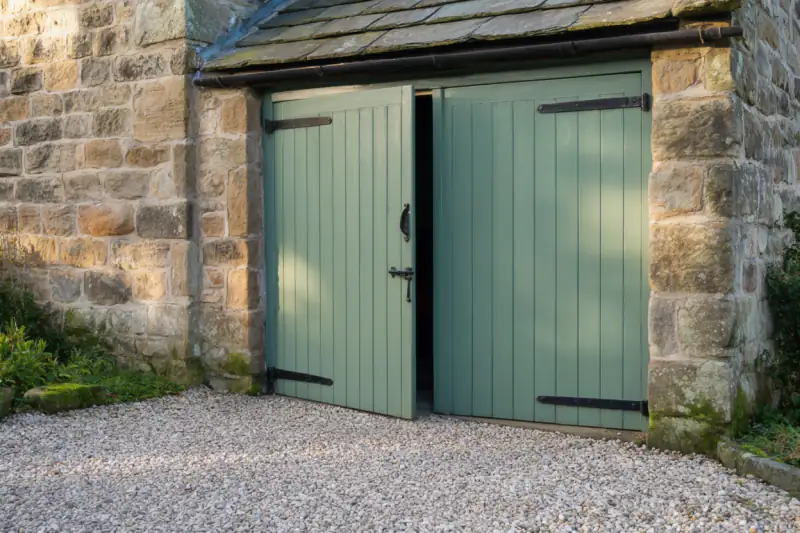
Electric side-hinged garage doors are a pair of leaves hung on the frame, opening outwards like gates, with a motor kit doing the pushing and pulling. They suit older homes, workshops and anyone who wants the ceiling left free. They are also usually the most expensive door to buy new, at about £1,500 to £3,500 fitted on typical 2026 UK guides, so it helps to know what that money buys and when it makes sense to spend it.
How a pair of hinged doors runs on a motor
Each leaf has to be driven, which is the big difference from a door that lifts in one piece. A dedicated kit moves the leaves in the right order and closes them in the right order, so that one sits correctly against the other. That makes this the most involved type to automate, and the reason a standard ceiling opener is not usually the answer.
There is one thing in its favour. Side-hinged doors have no lifting springs or cables, so the most dangerous parts of other garage doors are not here at all. The weight hangs on the hinges and frame instead, which puts all the pressure on those being strong and square.
Opening one leaf or both
Many owners find this the most useful part of the design. You can open one leaf to fetch a bike or some tools, then leave the rest of the garage shut. With a workshop, that means no need to open the whole front on a cold morning. Whether one leaf can run alone on the remote depends on the kit, so tell us if it matters to you.
Who side-hinged doors suit best
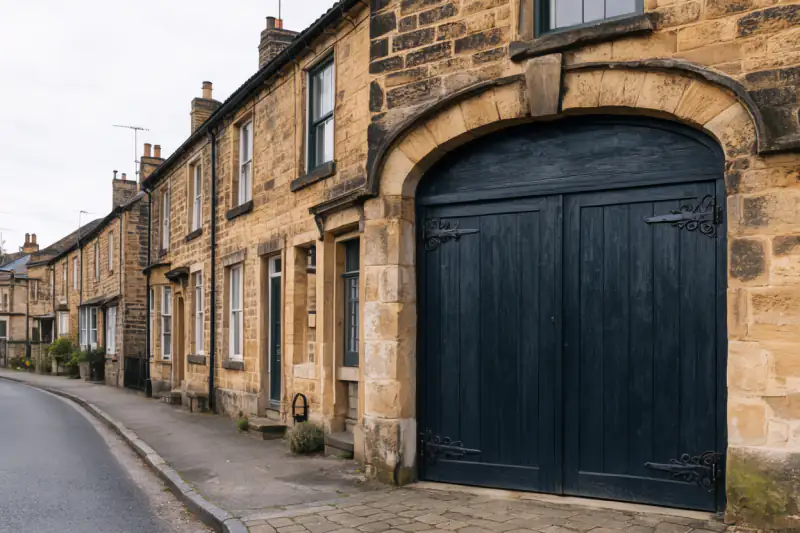
Character is the usual reason. A timber or timber-look pair sits comfortably on a stone house or an older detached garage, where a modern slatted door could look out of place. Near the centre of Morpeth, for instance, a traditional door often suits the building better. Parts of Durham city are in a conservation area. If your home could be affected, check with the local authority before you change the look of the front.
Workshops are the other good fit. With nothing overhead, you have the full height for racking or long timber. Openings that are too low or too irregular for tracks can often still take a hinged pair as well.
They suit some homes poorly, and the drive is usually the reason. On a short or steep drive, the leaves may have nowhere to swing, and anyone who parks close to the garage will need to back up every time they open it. A rising drive can catch the bottom of the leaves, and a narrow back lane will rule them out altogether. For those garages, a door that lifts straight up is the kinder choice, and our door types overview sets out the options.
Measuring the swing
Most garage doors are measured largely from the inside. This one is measured from the drive. Each leaf sweeps out an arc as wide as the leaf itself, so a tape measure and some chalk will show you the space involved. Mark the arc on the ground, then see what falls inside it.
Check these points while you are out there:
- The arc of each leaf, with room to spare at the end of its swing.
- Any rise in the ground, as a leaf needs to clear it all the way round.
- Whether the leaves can open fully against a wall, a fence or a neighbour's drive.
- How the wind catches the leaves when they stand open.
Indoors, you still need to look at the frame. The doors must be strong, square and able to swing freely, and the kit needs firm fixings at the sides of the opening. A new pair is made to measure, so a non-standard opening is often less of a worry than it would be with a stock door.
Automating doors you already have
Sometimes your existing doors can be kept, and it is often the first thing people ask us. It depends on their condition more than their age. A heavy old pair that drags on the ground or leans on its hinges will strain the kit and trip the safety systems, so that has to be put right first. We check the hinges, frame and swing before recommending anything, much as we would for any of the existing doors people ask us to motorise.
Motors, power and locking
The chain, belt and direct drive choice you read about for other doors does not really apply here, because those openers suit doors that lift. The decision is more about a kit that matches the weight and width of your leaves. The guide prices for those drives are not a fair way to judge this job, so we will quote for the kit that suits your doors.
The kit needs power close by, and a new socket typically costs £80 to £150. Older detached garages sometimes have no electricity at all, in which case a qualified electrician should deal with that first. Any existing bolts and locks need thought too, since a motor cannot open a door held by a floor bolt. We will explain what applies to your doors. Our automation page has more on converting a manual door.
Costs in plain figures
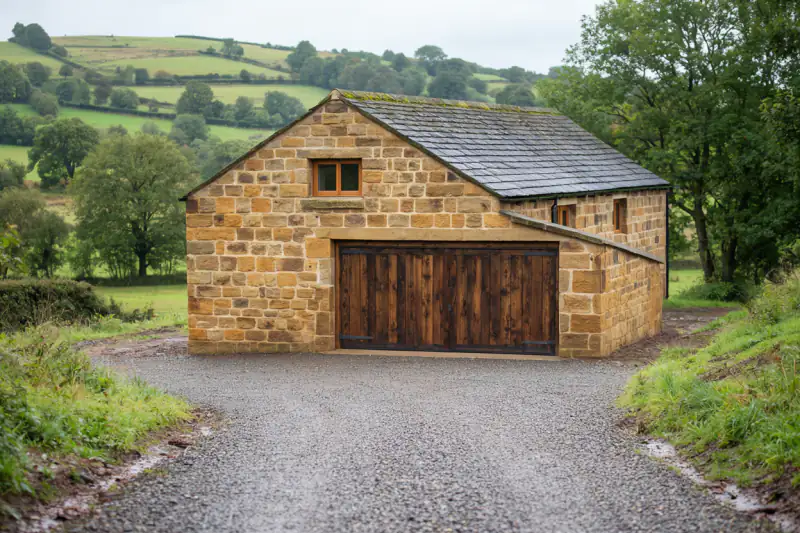
Typical 2026 UK guide figures for a single garage put a new electric side-hinged door at £1,500 to £3,500 fitted, and £1,100 to £2,800 supply only. They are not our price list. Material and size drive the spread, and the fitting has to allow for setting up both leaves and their safety systems. A battery backup, at £50 to £120, and a Wi-Fi module, at £30 to £60, are optional extras. Running costs stay under £25 a year for most households.
You can compare those figures with other door types on our price guide. If side-hinged is more than you hoped to spend, it may be worth asking whether a lifting door with a traditional look would do the same job.
Looking after timber, steel and GRP doors
Upkeep depends on the material. Timber looks the part, but it needs repainting or restaining to stop it from moving and rotting, and a door that swells can start to bind. Steel is strong, though it needs any chips touched up before rust takes hold, particularly near the sea. GRP is the easy one, as a wash with soapy water is usually enough.
Whatever the material, look at the hinges and fixings a few times a year, and watch for a leaf that begins to drop. Test the safety features monthly, following your manual, because a moving leaf can trap fingers at its hinges and meeting edge. A door that starts to catch or reverse by itself may need a repair.
Side-hinged doors reward the right garage with a clear ceiling and a traditional look. If your drive has room for the swing, send the width, the height and a photo through the quote form at the top of this page. We will tell you what is possible with your opening or your existing doors.